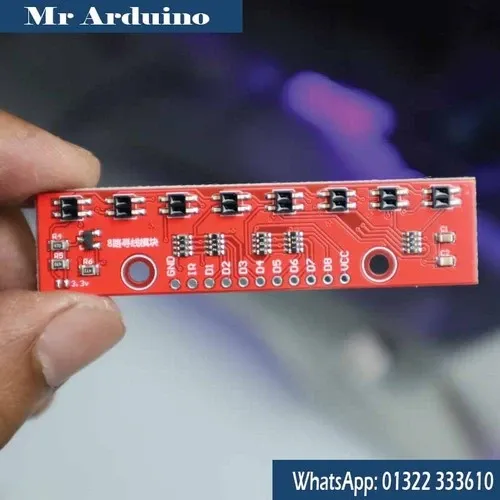
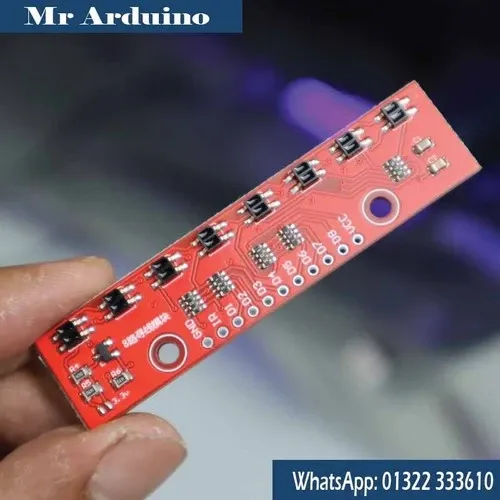
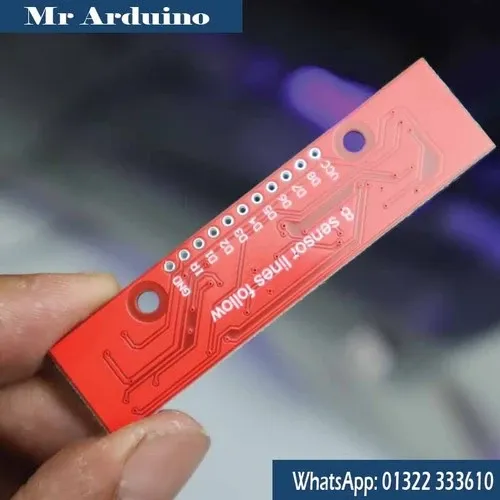
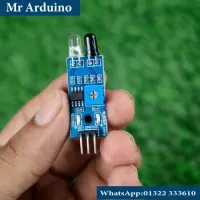
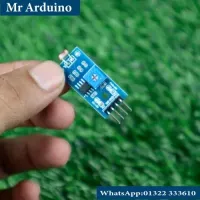
The Line Follower Sensor - 8 Array is a versatile and highly effective sensor module used primarily in robotics and automation systems for line tracking applications. It features 8 infrared (IR) sensors arranged in an array, designed to detect the contrast between a line (usually black) and the surface (typically white) beneath it. This sensor array is most commonly used in line-following robots, where it helps the robot detect and follow a path or track on the ground.
The 8-sensor array provides high resolution and better accuracy in detecting the line's position, allowing robots to follow curves, intersections, and more complex paths. Each sensor in the array can independently detect whether it is on the line or off the line. The sensor data can then be processed by a microcontroller (e.g., Arduino) to control the robot's movement in real time.
How It Works:
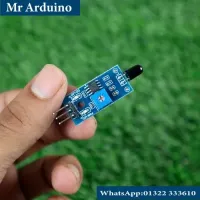
The Line Follower Sensor - 8 Array works based on infrared (IR) light emission and reflection. Each of the 8 IR sensors has an infrared emitter and a photodetector (usually a photodiode or phototransistor) that detects the reflected infrared light from the surface below.
- When the sensor is over a light-colored surface (e.g., white): The infrared light is reflected back into the sensor, which triggers a "high" signal (logic 1).
- When the sensor is over a dark surface (e.g., black line): Less infrared light is reflected, and the sensor generates a "low" signal (logic 0).
The microcontroller processes the signals from all 8 sensors to determine the position of the line and adjust the movement of the robot accordingly. This enables the robot to follow the line, stay centered on it, or make adjustments when the line deviates.
The 8-array configuration allows for more precise tracking, particularly when handling curves or when more complex decision-making is needed for maneuvering around obstacles or intersections.
Key Features:
- 8-Sensor Array: Provides greater accuracy and resolution compared to single-sensor line follower modules, improving the robot's line-following capability.
- Infrared (IR) Sensing: Uses infrared light to detect the contrast between the line and the surface, ensuring reliable detection even in varying lighting conditions.
- High Sensitivity: The sensors are sensitive enough to detect both thin and thick lines, making them suitable for a wide range of applications.
- Compact Design: Small and easy to integrate into various robotic systems, suitable for DIY projects, competitions, or educational purposes.
- Digital Output: The sensor provides digital output signals (high or low) that can be easily read by a microcontroller like Arduino or Raspberry Pi.
- Adjustable Sensitivity: Some versions of the module allow users to adjust the sensitivity of the sensors for better performance in different environments.
- Easy Integration: Compatible with popular microcontrollers, making it perfect for line-following robot projects or automation systems.
Specifications:
- Sensor Type: 8 IR emitter and detector pairs (one for each sensor)
- Detection Distance: Typically 1–3 cm from the surface for accurate detection
- Output Type: Digital (HIGH/LOW)
- Operating Voltage: Usually 5V DC, but some modules can also operate with a voltage range of 3.3V to 5V
- Sensor Resolution: 8 sensors provide high-resolution tracking, allowing for better accuracy when following the line.
- Sensitivity Adjustment: Some modules have a potentiometer for adjusting the sensitivity of the sensors.
- Sensor Spacing: Sensors are arranged in a linear array, often with equal spacing to cover a larger portion of the track.
- Board Dimensions: Typically around 5 cm x 2.5 cm, compact and easy to fit into small robotic chassis.
- Output Voltage: Typically 0V (low) or 5V (high) depending on the sensor's position relative to the line.
Applications:
- Line Following Robots: Commonly used in robot competitions and projects, where the robot needs to follow a path or track autonomously.
- Automation Systems: Can be used in automated systems where path tracking or movement along predefined tracks is required (e.g., automated guided vehicles).
- Obstacle Detection: Can be used in conjunction with other sensors to enable robots to detect and avoid obstacles while following a line.
- Educational Projects: Ideal for teaching robotics, programming, and sensor integration in STEM (Science, Technology, Engineering, and Mathematics) environments.
- Industrial Applications: Used in conveyor belts and automated manufacturing systems to track objects along a specific path.
Limitations:
- Line Color Sensitivity: The sensor array works best with high-contrast lines (black on white). It may struggle to detect low-contrast lines or lines that are not dark enough (e.g., very light gray on white).
- Environmental Conditions: The sensor's performance can be affected by ambient lighting conditions. Bright lights or sunlight may interfere with infrared light detection.
- Limited Range: The effective detection range is usually around 1-3 cm. If the sensor is positioned too far above the line or if the track is uneven, the detection quality may decrease.
- Straight Line Tracking: While the 8-sensor array offers good resolution, tracking complex curves or sharp turns may still require fine-tuning of the robot's algorithms or additional sensors.
The Line Follower Sensor - 8 Array is an essential tool for any line-following robot project or automation system that requires precise tracking capabilities. Its ability to detect lines with high resolution makes it an excellent choice for more advanced robotics and automation projects, offering reliable and accurate line-following performance in various environments.